
Create directional heatmaps across continuous & binary variables
Source:R/PlotDirectionalHeatmaps.R
PlotDirectionalHeatmaps.RdCombines:
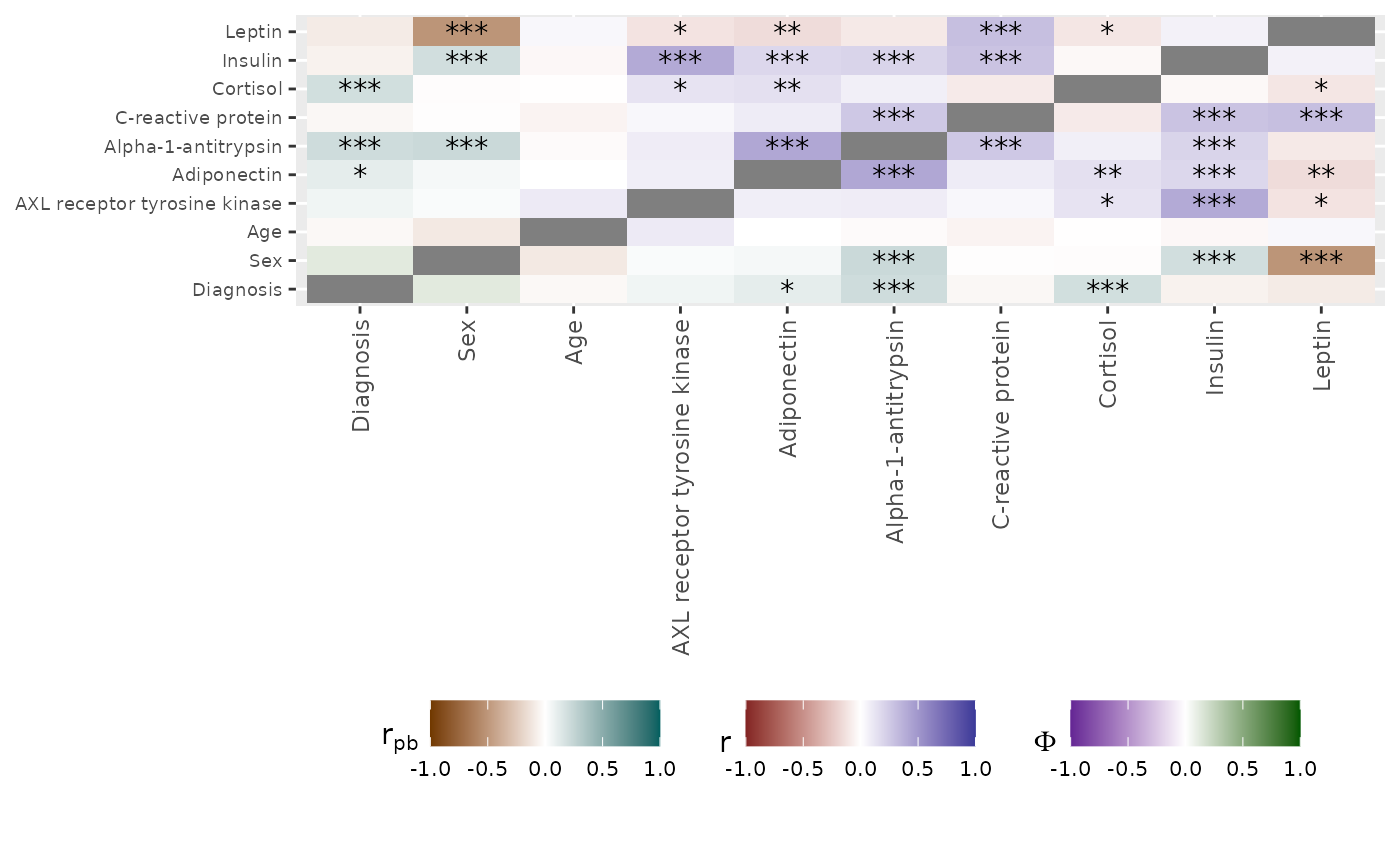
Continuous~Continuous (Pearson/Spearman)
Binary~Binary (Phi; 1 == PositiveLevel)
Binary~Continuous (r_pb; 1 == PositiveLevel) into a single square heatmap with raw and FDR-star overlays.
Usage
PlotDirectionalHeatmaps(
  data,
  variables = NULL,
  Relabel = TRUE,
  Ordinal = TRUE,
  fdr_scope = c("matrix", "per_outcome", "per_predictor"),
  cluster_rows = FALSE,
  cluster_columns = FALSE,
  triangle = c("full", "upper", "lower"),
  IncludeTrendSymbol = FALSE,
  Data = lifecycle::deprecated(),
  xVars = lifecycle::deprecated(),
  yVars = lifecycle::deprecated()
)
Arguments
- data
A dataframe.
- variables
Character vector of variables to include (subset of
datacolumns). The analysis is symmetric: every variable is related to every other, so a single variable set defines both axes. If NULL, uses all detected continuous + binary vars.- Relabel
Logical; use sjlabelled variable labels if present.
- Ordinal
Logical; passed to
PlotPointCorrelationsHeatmap()for the binary~continuous block, where it controls whether ordinal variables are treated as continuous. Defaults toTRUE.- fdr_scope
Either
"matrix"(default) or"per_outcome", threaded through to the three sub-analyses (PlotCorrelationsHeatmap(),PlotPhiHeatmap(),PlotPointCorrelationsHeatmap()). Correction is applied within each sub-analysis block (continuous~continuous, binary~binary, binary~continuous), matching historical behavior; each sub-function's documented outcome orientation applies within its block.- cluster_rows, cluster_columns
Logical; cluster heatmap rows and columns.
- triangle
Display
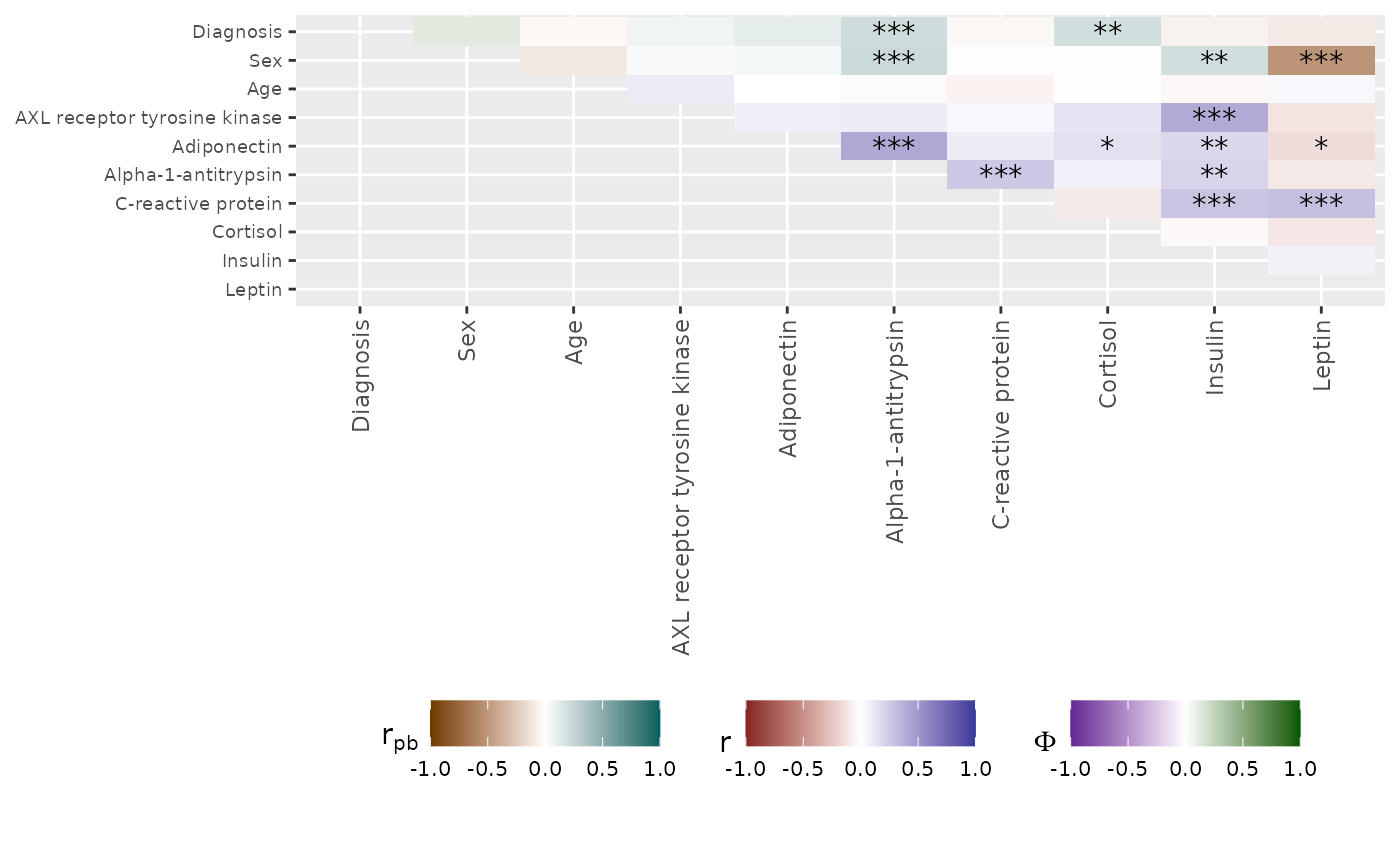
"full"(default),"upper", or"lower"half of a symmetric directional matrix. This affects plots only and is applied only when the same variables occur on both axes.- IncludeTrendSymbol
Logical; add a plus sign for
0.05 < p <= 0.10.- Data
Deprecated (since 19.15.0). Use
datainstead.- xVars
Deprecated (since 19.15.0). Use
variablesinstead.- yVars
Deprecated (since 19.15.0). Use
variablesinstead. If supplied, the old rectangular x-by-y display is still honored.
Details
Constant variables (no variation in the current data) are automatically excluded before computing any tiles.
Note
The analysis covers continuous and binary variables. Multi-level categorical
variables (more than two levels) are not placed on the heatmap. Ordinal
affects only the binary~continuous block, which is the one sub-analysis that
accepts it.
Examples
data(SampleData)
data(SampleVariableTypes)
# Attach labels and factor levels so binary variables are detected and
# axis labels are readable
Labelled <- RevalueData(SampleData, SampleVariableTypes)$RevaluedData
# A mix of binary categorical (Diagnosis, sex) and continuous variables
result <- PlotDirectionalHeatmaps(
Labelled,
variables = c("Diagnosis", "sex", "age", "AXL", "Adiponectin",
"Alpha_1_Antitrypsin", "C_Reactive_Protein", "Cortisol",
"Insulin", "Leptin")
)
# Raw p-value directional heatmap
result$Unadjusted$plot
#> Warning: Removed 4 rows containing missing values or values outside the scale range
#> (`geom_text()`).
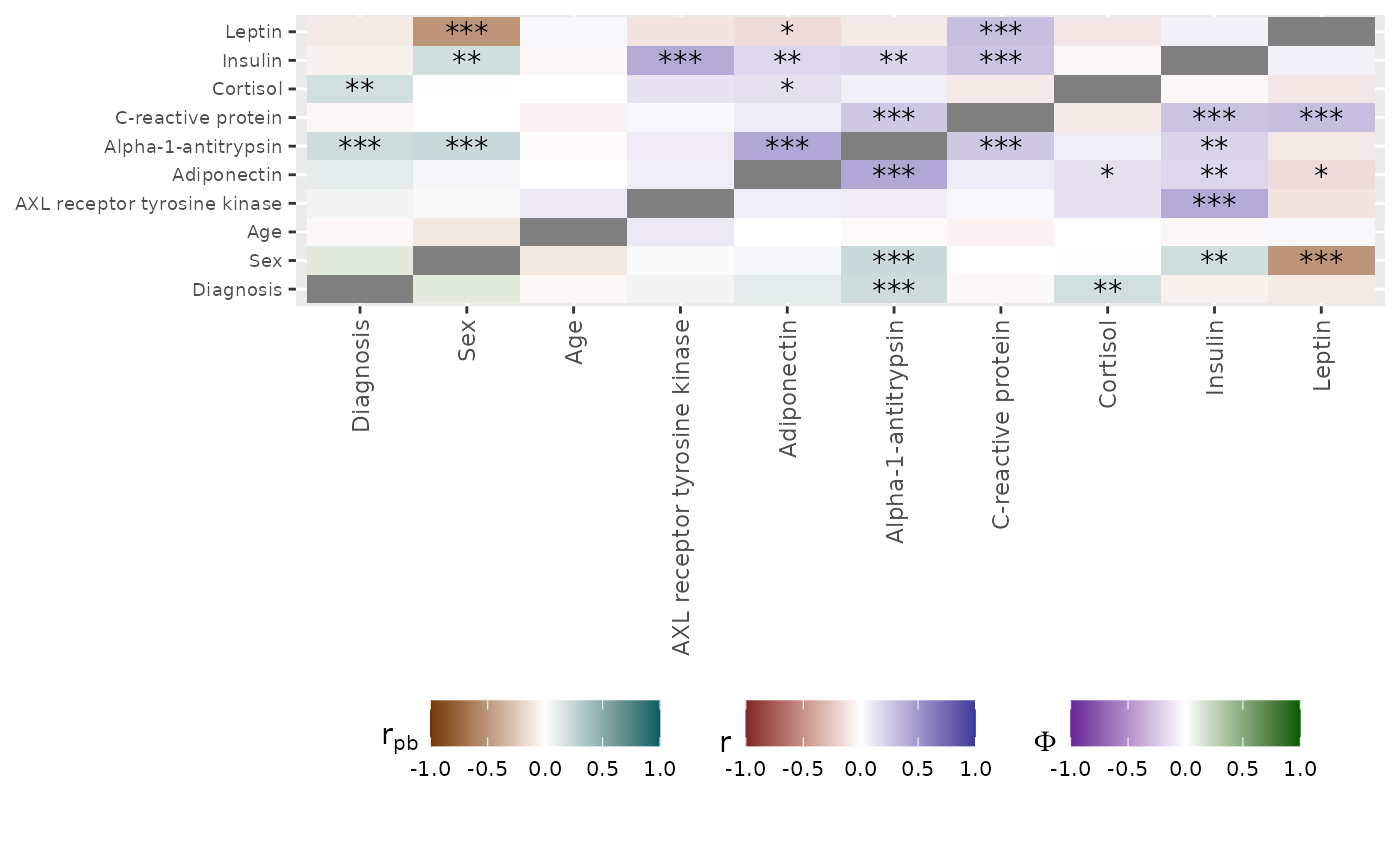
 # FDR-adjusted directional heatmap
result$FDRCorrected$plot
#> Warning: Removed 4 rows containing missing values or values outside the scale range
#> (`geom_text()`).
# FDR-adjusted directional heatmap
result$FDRCorrected$plot
#> Warning: Removed 4 rows containing missing values or values outside the scale range
#> (`geom_text()`).
 # Show each symmetric variable pair once.
upper <- PlotDirectionalHeatmaps(
Labelled,
variables = c("Diagnosis", "sex", "age", "AXL", "Adiponectin",
"Alpha_1_Antitrypsin", "C_Reactive_Protein", "Cortisol",
"Insulin", "Leptin"),
triangle = "upper"
)
upper$FDRCorrected$plot
#> Warning: Removed 1 row containing missing values or values outside the scale range
#> (`geom_text()`).
# Show each symmetric variable pair once.
upper <- PlotDirectionalHeatmaps(
Labelled,
variables = c("Diagnosis", "sex", "age", "AXL", "Adiponectin",
"Alpha_1_Antitrypsin", "C_Reactive_Protein", "Cortisol",
"Insulin", "Leptin"),
triangle = "upper"
)
upper$FDRCorrected$plot
#> Warning: Removed 1 row containing missing values or values outside the scale range
#> (`geom_text()`).
 # How binary variables were coded (which level counts as the positive one)
result$BinaryMapping
#> Variable Label PositiveLevel NegativeLevel
#> 1 Diagnosis Diagnosis Impaired Control
#> 2 sex Sex Male Female
# How binary variables were coded (which level counts as the positive one)
result$BinaryMapping
#> Variable Label PositiveLevel NegativeLevel
#> 1 Diagnosis Diagnosis Impaired Control
#> 2 sex Sex Male Female