
Plot Interaction Effects Matrix
Source:R/PlotInteractionEffectMatrix.R
PlotInteractionEffectsMatrix.RdCreates a heatmap visualization of interaction effects between continuous variables, showing whether interactions result in slope reversals or maintain the same direction.
Usage
PlotInteractionEffectsMatrix(
  data,
  interVar = NULL,
  outcome_vars = NULL,
  predictor_vars = NULL,
  covariates = NULL,
  Relabel = TRUE,
  Ordinal = lifecycle::deprecated(),
  TreatOrdinalAs = "Exclude",
  Data = lifecycle::deprecated(),
  outcomeVars = lifecycle::deprecated(),
  predictorVars = lifecycle::deprecated(),
  fdr_scope = c("matrix", "per_outcome", "per_predictor"),
  covars = lifecycle::deprecated()
)
Arguments
- data
A data frame containing the variables to be analyzed
- interVar
Character string specifying the interaction variable (moderator). Can be categorical or continuous.
- outcome_vars
Character vector of outcome variable names (displayed on rows)
- predictor_vars
Character vector of predictor variable names (displayed on columns)
- covariates
Character vector of covariate names to include in the models
- Relabel
Logical indicating whether to use variable labels if available (default: TRUE)
- Ordinal
Deprecated (since 20.20.0). Use
TreatOrdinalAsinstead.- TreatOrdinalAs
How ordinal variables are handled. This interaction matrix accepts
"Exclude","Continuous", or"Categorical". Categorical ordinal outcomes are not supported by the linear models.- Data
Deprecated (since 19.15.0). Use
datainstead.- outcomeVars
Deprecated (since 19.15.0). Use
outcome_varsinstead.- predictorVars
Deprecated (since 19.15.0). Use
predictor_varsinstead.- fdr_scope
Either
"matrix"(default) or"per_outcome", passed toApplyFDRCorrection()."matrix"corrects across all interaction p-values at once (historical behavior)."per_outcome"corrects separately within each outcome variable (outcome_vars).- covars
Deprecated (since 19.15.0). Use
covariatesinstead.
Value
A list containing:
- Unadjusted
List with unadjusted results including:
C: Matrix of interaction coefficients
S: Matrix of slope direction indicators (1 = same, -1 = reversed)
P: Matrix of p-values
D: Matrix of interaction coefficient signs
Slope1: Matrix of slopes at low values of interVar (mean - 1SD for continuous, reference group for categorical)
Slope2: Matrix of slopes at high values of interVar (mean + 1SD for continuous, comparison group for categorical)
plot: ggplot object of the heatmap
pvaltable: P-value table in wide format
- FDRCorrected
List with FDR-corrected results (same structure as Unadjusted)
- Relabel
Logical indicating whether relabeling was applied
- Covariates
Character vector of covariates used
- interVar
The interaction variable name
- raw_data
Processed data frame with all calculated values
Details
The function fits linear models of the form: outcome ~ predictor * interVar + covariates for each combination of outcome and predictor variables.
For continuous interaction variables, slopes are calculated at mean - 1SD and mean + 1SD. For categorical interaction variables, slopes are calculated for each category.
The function then determines whether the interaction causes a slope reversal (opposite signs) or maintains the same direction (same signs) for the predictor-outcome relationship.
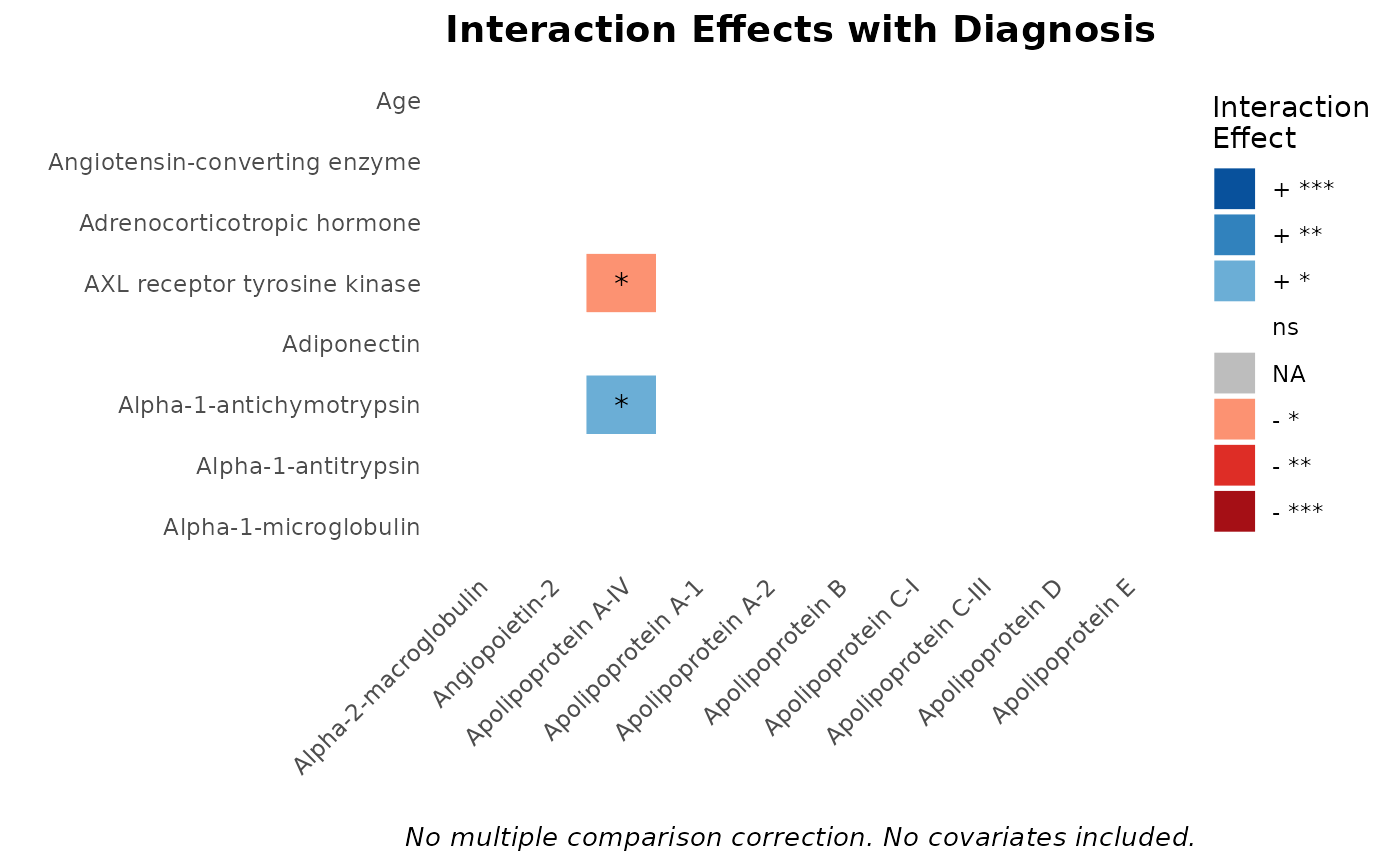
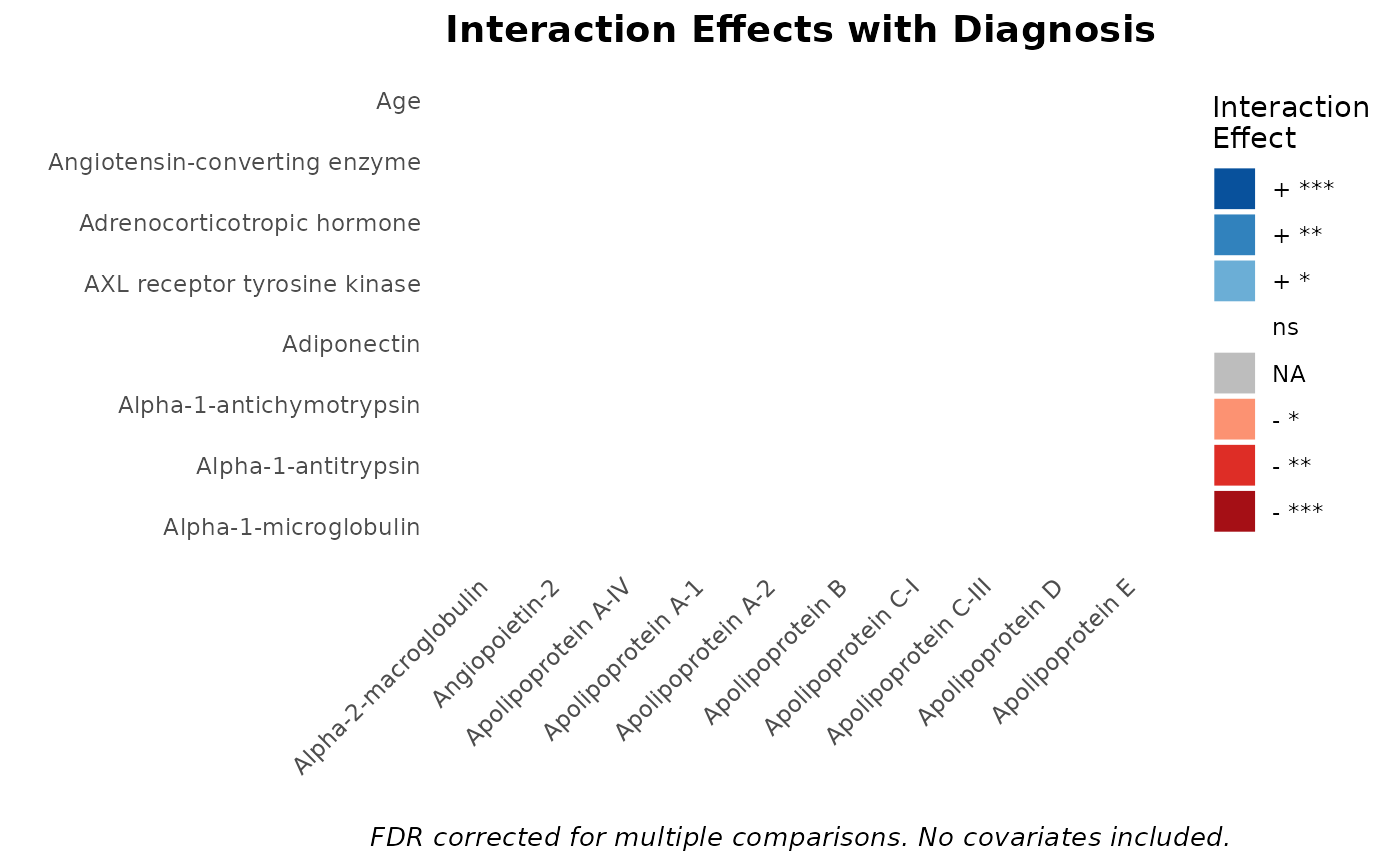
Color coding:
Blue gradient: Significant interaction with slopes in the same direction
Red gradient: Significant interaction with slope reversal
White: Non-significant interaction (p > 0.05)
Grey: Missing data or model could not be fit
Darker colors indicate higher significance:
***: p <= 0.001 (darkest)
**: p <= 0.01 (medium)
*: p <= 0.05 (light)
Examples
# \donttest{
data(SampleData)
data(SampleVariableTypes)
# Attach labels and factor levels for readable axes
Labelled <- RevalueData(SampleData, SampleVariableTypes)$RevaluedData
outcomes <- c("age", "ACE_CD143_Angiotensin_Converti",
"ACTH_Adrenocorticotropic_Hormon", "AXL", "Adiponectin",
"Alpha_1_Antichymotrypsin", "Alpha_1_Antitrypsin",
"Alpha_1_Microglobulin")
predictors <- c("Alpha_2_Macroglobulin", "Angiopoietin_2_ANG_2",
"Apolipoprotein_A_IV", "Apolipoprotein_A1",
"Apolipoprotein_A2", "Apolipoprotein_B", "Apolipoprotein_CI",
"Apolipoprotein_CIII", "Apolipoprotein_D", "Apolipoprotein_E")
# With a categorical interaction variable (Diagnosis)
results <- PlotInteractionEffectsMatrix(
data = Labelled,
interVar = "Diagnosis",
outcome_vars = outcomes,
predictor_vars = predictors
)
# With a continuous interaction variable (age)
results_cont <- PlotInteractionEffectsMatrix(
data = Labelled,
interVar = "age",
outcome_vars = setdiff(outcomes, "age"),
predictor_vars = predictors
)
# Raw p-value interaction matrix
results$Unadjusted$plot
 # FDR-adjusted interaction matrix
results$FDRCorrected$plot
# FDR-adjusted interaction matrix
results$FDRCorrected$plot
 # }
# }